

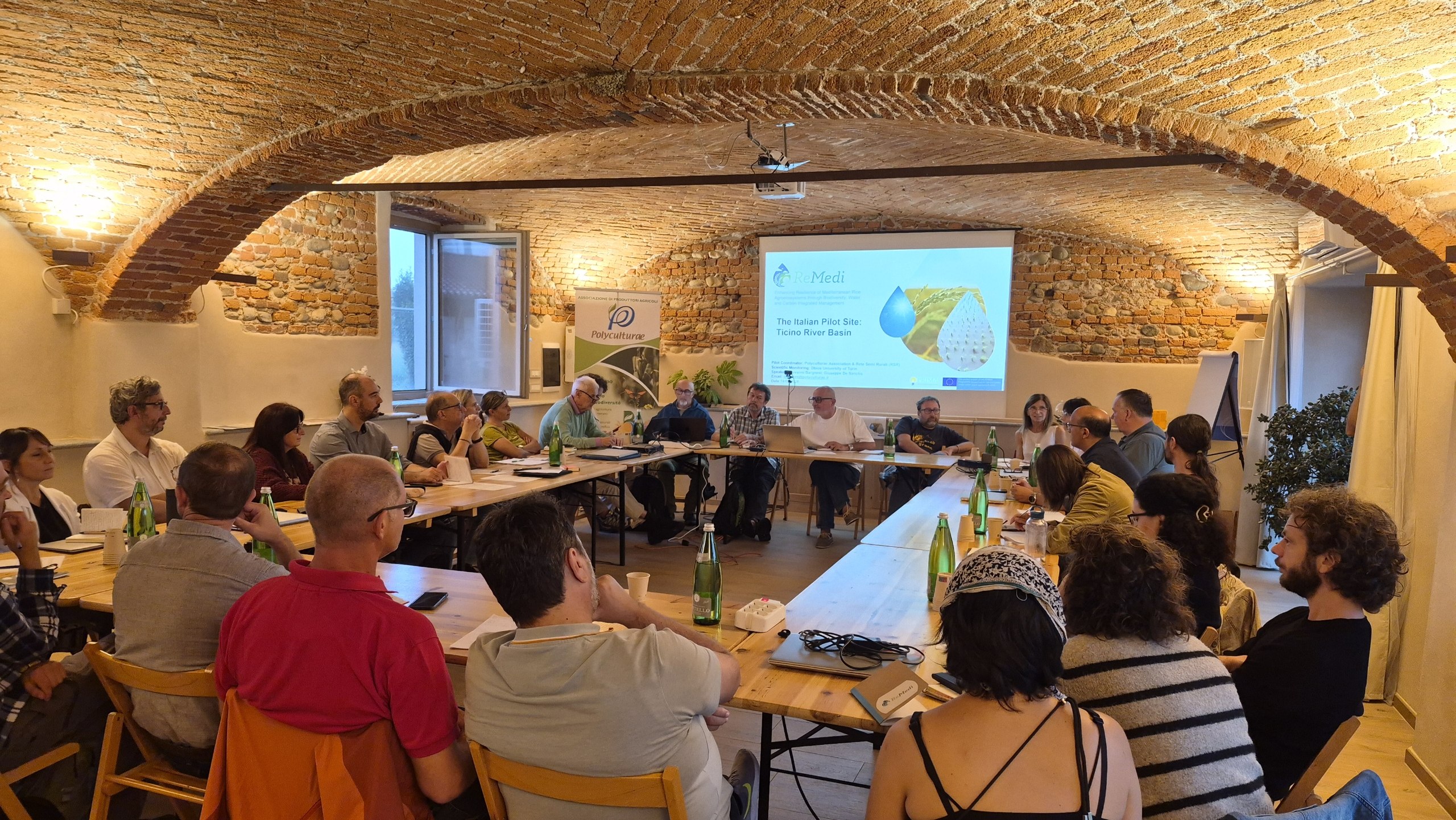
The ReMedi project held its first co-design workshop for the Italian Living Lab on 18 September 2026 at Azienda Agricola Una Garlanda in Rovasenda, Vercelli, Italy. The meeting, hosted by Polyculturae in collaboration with Rete Semi Rurali, marked an important step in bringing the project’s Living Lab approach into practice, creating a space where rice farmers, researchers and local stakeholders could exchange knowledge and contribute directly to the design of project activities.
During the workshop, participants were introduced to the Italian Living Lab ecosystem, the international ReMedi consortium and the four pilot farms involved in the Italian site, as well as the environmental monitoring activities that will support the project.
Bringing farmers’ experience into the project
A central part of the day was dedicated to listening to farmers and other stakeholders from the territory. Participants discussed their operational needs and the environmental and landscape context in which rice farming takes place, while also identifying some of the barriers that can make the adoption of sustainable practices more difficult.
The discussion then moved into a World Café co-design session using a “Cross-Pollination” approach. One working table focused on the sustainable practices proposed within ReMedi and the indicators that could be tested and monitored locally. A second table explored the Living Lab methodology itself and how the approach developed in Italy could later be replicated across the project’s other Mediterranean pilot sites. Participants subsequently exchanged between groups and brought the different perspectives together through a visual harvesting exercise.
The workshop concluded by evaluating the co-design method tested during the day and discussing the next steps for the Italian Living Lab.
From discussion to action across the Mediterranean
The Italian Living Lab workshop took place immediately after the ReMedi WP3 Mediterranean Pilot Site Planning Workshop, held in Rovasenda on 16–17 September. During that meeting, project partners translated their discussions into a joint action plan for the following months, covering pilot-site coordination, environmental monitoring, water management and the development of the Living Lab methodology.
Among the agreed next steps, each pilot site will identify its relevant water catchment and key stakeholders and connect ReMedi activities and indicators with water-, biodiversity- and carbon-management objectives.
Together, the meetings in Rovasenda helped move ReMedi from planning towards implementation, ensuring that the project’s solutions are developed not only for Mediterranean rice-growing communities, but with the people who manage and depend on these landscapes.
ReMedi aims to address rice cultivation and wetlands as an interconnected system, integrating agricultural production and nature conservation by working with farmers and other local actors to develop more resilient and biodiverse Mediterranean agricultural landscapes, which are highly vulnerable to climate change impacts.